Portfolio
Devotions / 2022
violin, cello, & harmonium
commissioned by longleash (Pala Garcia, John Popham, & Julia Den Boer)
supported by New Music USA
link to score ︎
recorded by longleash, August 13, 2022 at The Loretto Motherhouse, Nerinx, Kentucky
In Devotions, I drew on a 13th motet, Ne m'a pas oublié, extracting little melodic strands, turns of phrases, and harmonic slices, fusing them with my own expressions and sensibilities. The motet and my own music had considerable overlap—lulling, narrowness, smearing, repetitiveness, and serenity. But what was new for me, yet native to the motet, was the assemblage of and engagement with historical musical materials. In medieval motets the bottom voice is borrowed from plainchant and often altered. In Ne m'a pas oublié, for instance, the Easter gradual Haec dies is excerpted into fragmented phrases which are structured anew to form the tenor line. I composed with a similar attitude, excavating and reworking snippets and contours of this motet to make my own music, borrowing with a very light touch, keeping the motet more in my peripheral vision, strewn on the floor, tacked to the wall, than "on the stand" in front of me. In the process, historical meanings and materials become renovated and warped, the voices becomes voiceless. Yet, a sense of singing remains in the phrasing, range, and expression. This sort of "inbetweenness"—here, between instrument and voice—is a hallmark of motets: they flicker between the divine and earthly, the eternal and now, the cantor and troubadour.
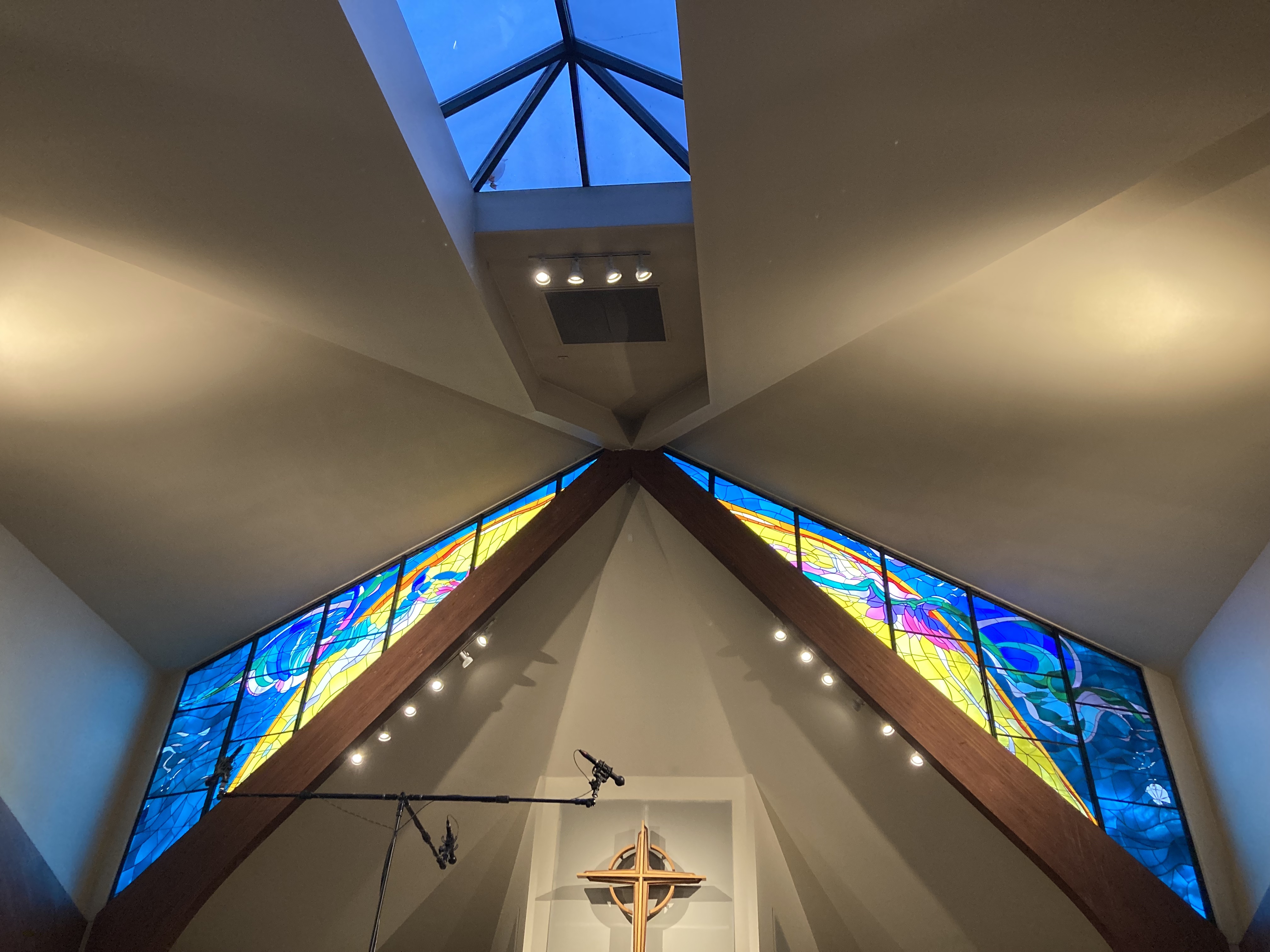
The Song of St. Bazetta / 2022
electric guitar, bass clarinet, and orchestra
commissioned by Steven Schick and The La Jolla Symphony Orchestra & Chorus and supported by the Thomas Nee Fund
link to audio︎
link to score︎
Performed by Madison Greenstone, Anthony Vine, and The La Jolla Symphony Orchestra & Chorus, June 3, 2022 at The Good Samaritan Church, La Jolla, California
There is a place called Bazetta. The etymological origin of its name is unknown. Bazetta is unremarkable in terms of its topography—tracts of uncultivated land adjoin with manicured lawns and linoleum-sided split level homes—yet it has an undeniable mystical presence: “a land for seeking esoteric spiritual truths,” as one hagiographer notes. Eremites came there instinctually, following an “ultra-thin allure,” and lived in the chestnut trees. Concealed by foliage, the eremites could only be heard praying. Their devotions were always sung, like angelic choirs who are believed to sing eternally in the presence of God. As the early music practitioner Christopher Page notes, the devotional singing of the eremites and their contemporaries was “not the self-conscious and extroverted activity that we [today] associate with performing.” They sang to more fully embody the spiritual meanings of their recitations, litanies, and testimonies. But that is not to say their intonations were not carefully tended to, nor deeply aesthetic. “Potent devotion beckons sonorous ecstasy.”
Hagiographic texts tell of a prodigious eremite from the forests of Bazetta whose voice “could still the sublunary world.” Walking aimlessly through the groves of chestnut trees one night, a prelate of the area, who had been afflicted by an inexplicable, generalized uneasiness for many years, suddenly felt a peculiar humming course through him. “I heard a tone like that of roaring waters… of a seraphim’s wings,” he recounted, “and awoke the next morning in the duff and detritus cured of my malaise.” The healing of the prelate was the first of many miracles attributed to the hermit, who was canonized and given the toponymic name St. Bazetta.
“The Song of St. Bazetta” is a fantastical reimagining of the devotional singing of St. Bazetta and the eremites of the region. The musicians sound with one voice, ceaselessly, in alternating choirs. They dwell upon the natural resonances of their instruments, following the slow undulation of a liturgical tenor. Without words and adornments, all that remains in this song is the voice, vox prius facta (“the voice first made”), the sounds that form our every utterance.

Worshipful Company / 2023
a book of wordless chorales for violin and piano
link to audio︎
link to score︎
Performed by the Bennardo-Larson Duo.
Chorales are elemental. They are formed from a single melody, traditionally taken from a hymn or song, and supported by other voices which all move uniformly together. Due to their simple and rudimentary design, chorales are often used as pedagogical tools for young students to study part writing, harmony, and form. But the chorales written by Bach and other composers of the past were not conceived as exercises, but rather to communicate biblical texts, like psalms, in vernacular settings that were simple enough for large congregations of amateur musicians to sing. Chorales are functional, didactic, and communal. Richard Taruskin wrote that Lutheran chorales exhibit "extreme utilitarianism," and referred to their makers as "honest tradesman... that furnish an attractive, craftsmanly, not overly polished [music]." I do not see Worshipful Company as "functional music"; it does not seek to instruct or do anything other than provide a space for contemplative listening. However, it does carry the plainspoken surface of this music; they're easily understood. As Taruskin says of Lutheran music, Worshipful Company "seeks beauty in the commonplace."
Chorales first came into my life as practical things: music theory exercises. Their titles, like "Nun komm, der Heiden Heiland" ("Now come, Savior of the heathen"), and original context of performance and creation were never part of our lessons. Chorales were just forms, pure and perfect distillations of melody and harmony. We engaged with them theoretically as choral compositions—vocal parts needed to be in the correct ranges and move with the natural tendencies of the voice—yet I have few memories of singing them. Mostly, we plucked them away on shabby upright pianos in stuffy rooms or played arrangements of them in wind band, often just as warm up exercises to tune and blend. In theory classes, chorales were often analyzed and written without a single sound being made. Worshipful Company grows out of and extends the chorale's history of abstraction. They are without words, bowed and hammered, not written for four voices but for two, each of which plays many. But they undoubtedly carry the essence of the genre; they are structurally simple and immediate in expression, lyrical yet blocky songs, one voice made of many. Somehow this music for violin and piano registers as "sung," a reminder that the voice is the substance of so many things.
I wrote the chorales on different instruments—an antique pump organ, a baby grand piano, and an electric guitar—all of which left a strong imprint on their forms and characters. For example, the highly pressurized and continuous texture of No. 3 was written on organ; the very simple and naive melody and accompaniment of No. 11 was written on the piano; and the homophonic opening chorale, No. 1, with little passing tones in the bass, was written on guitar. All were written in a traditional SATB style, mostly as successions of chords, repeating in loops of different sizes, sometimes closing with conventional cadences, sometimes simply stopping. When scoring them for violin and piano I began to hear and pick out the melodies undergirding each. I orchestrated them partially alone and partially in situ with the violinist Maya Bennardo and pianist Karl Larson. In workshops, Maya and Karl read from vague sketches of the chorales from which we experimented with different doublings, registral shifts, and repeats until they "felt good" to all three of us. Imbuing the sensibilities and likings of the musicians recalled the collectivist attitude from which the title came, the livery companies of medieval London, each given the name “Worshipful Company of” their given trade: drapers, skinners, salters, dyers, barbers, bakers, curriers, masons, and musicians.