
Visiting Hours / 2023-25
In Rome, background music (BGM) plays not only in elevators and doctor's offices, but also in churches. From speakers mounted in marble, sacred music coats these spaces with a peaceful patina, inducing tranquility and masking extraneous noise. These recordings, ranging from solemn liturgical chant to blissful New Age instrumentals, are often contemplative and saccharine in expression, evoking the past to soften the edges of the present. Listening closely, one may glimpse how a church understands its past and who it imagines itself to be now.
From 2023 - 2024, I visited over seventy Catholic churches in Rome, making field recordings of the BGM I heard. The recordings were made by placing my phone against PA speakers and recording voice memos. Because BGM is generally played at low volume, the phone picked up details not heard otherwise, excavating what's hidden in this subliminally soft music. Due to the very colorful and vivid resonance of these large, vaulted churches, each field recording captures a strong sonic imprint of the church itself—its spatial volume, the presence of people, its goings-on—to such an extent, the recordings seem to transpose the very space where one is listening into the space emanating through the speakers.
What was captured were singular moments. One morning at Chiesa di San Pietro in Montorio, for instance, a few crickets found their way into the vestibule, chirping along with recordings of Gregorian chant, stopping momentarily whenever someone entered. In Chiesa di Sant'Ignazio di Loyola, the whispers of big crowds assembled to look up at Andrea Pozzo's monumental illusory frescoes floated in a bed of sparse and sentimental electric keyboard music playing softly over the speakers. A few times, I returned to Chiesa di Sant'Ignazio di Loyola to re-experience what I recorded, to hear what else was on this ecclesiastical playlist, but I found nothing. Maybe the sacristan forgot to press play, maybe the church calendar had something to do with it. How the music was selected, where it came from, when and why it was played was unclear. But knowing, I feel, would demystify the whole thing.
Seeking out church background music, I continually found myself in places that were nauseatingly garish and overwrought, manipulatively symmetrical and opulent. But they were also beautiful and beguiling, like the spiraling geometries of Borromini, as well as contemplative and heartfelt, like the piles of written prayers placed at the feet of statuary. What caught my eye again and again were the unremarkable and peripheral aspects of these churches—unkept corners, artificial plants, dingy candelabras, stacks of holy cards, empty bulletin boards, arrays of chairs and pews. When seen a certain way, at the right moment, these margins were unexpectedly sublime. I instinctually started taking photos, like any visitor to Rome, and an unforeseen collection began to take shape.
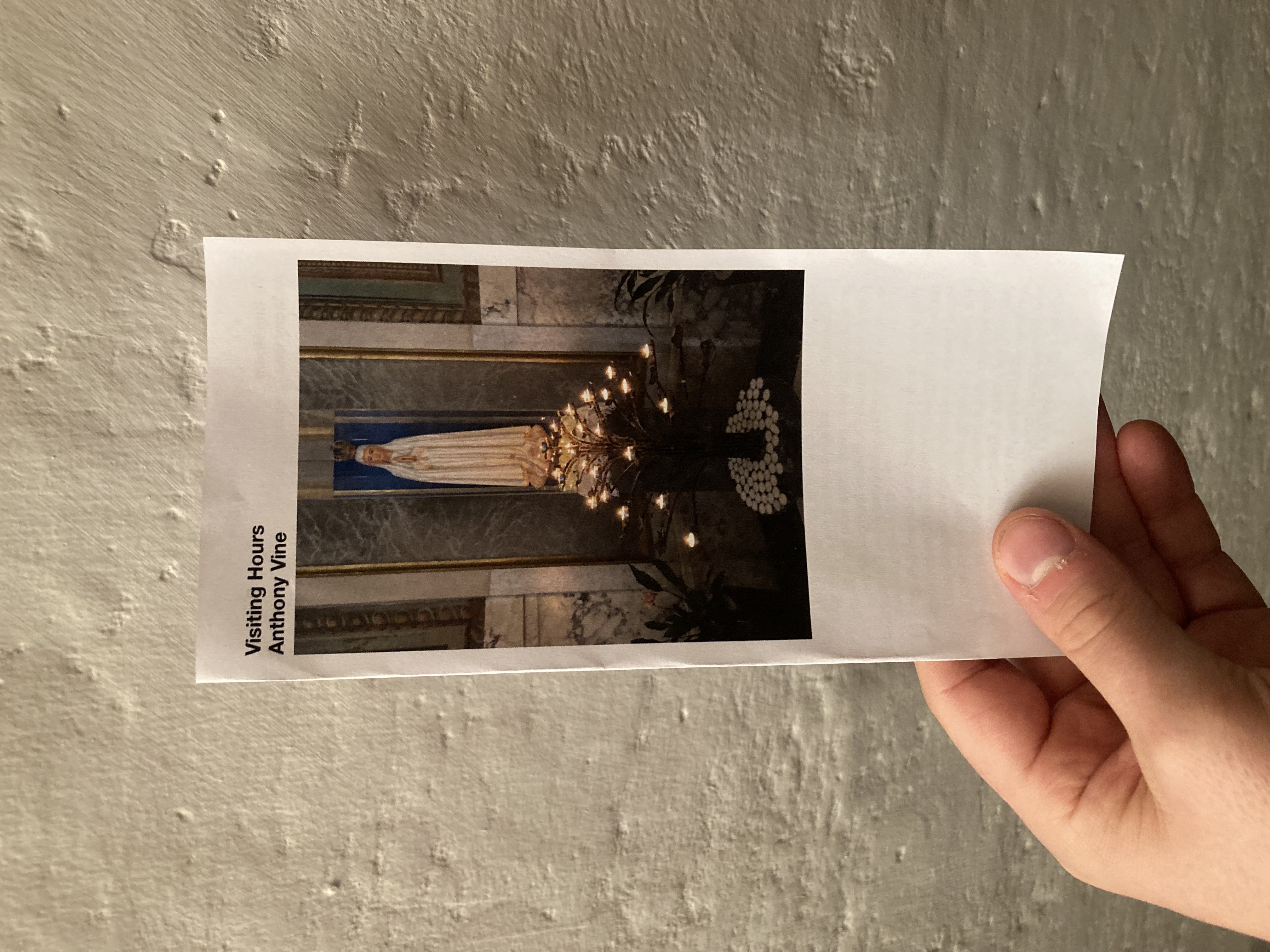
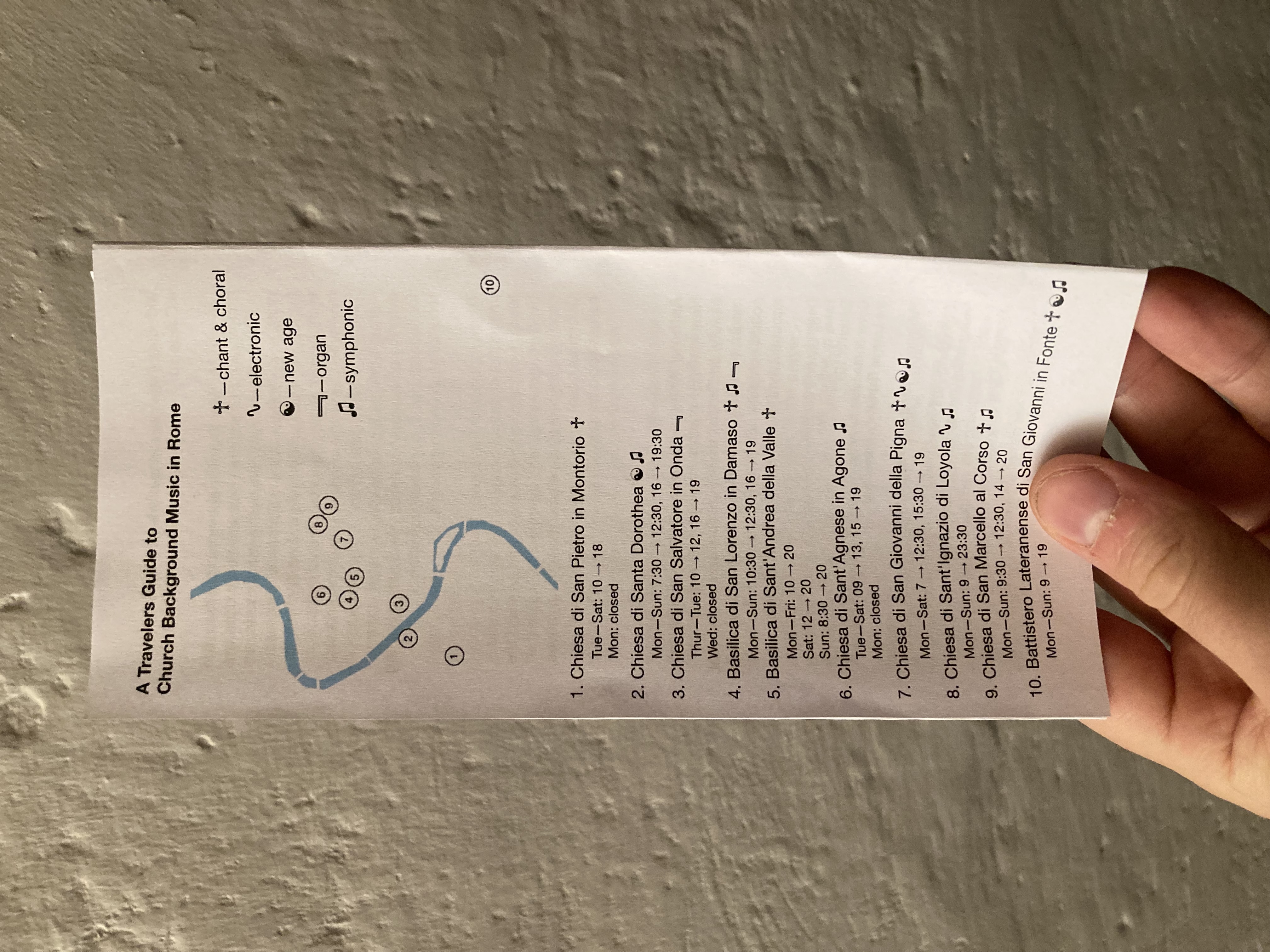
The strong spatial presence in both the BGM field recordings and the photographs gave me the idea to stage them as an installation. The installation, Visiting Hours, was organized along three categories—sound, light, and image—and consisted of field recordings of church background music played on loop, a video projection of an oil lamp flickering in a church, and a selection of my photographs printed as postcards for attendees to take from a "gift shop." I also published a pamphlet with a “traveler’s guide” to church background music in Rome, and some writing about the installation.
Visiting Hours is not just about the material, historical, and social contexts surrounding holy sites and tourism in Rome; it's also about the act of collecting, archiving, and excavating. As Italo Calvino writes in his essay Collection of Sand, “just like every collection, this one is a diary as well: a diary of travels, of course, but also of feelings, states of mind, moods… Or perhaps it is only a record of that obscure mania which urges us as much to put together a collection as to keep a diary, in other words the need to transform the flow of one’s own existence into a series of objects saved from dispersal, or into a series of written lines abstracted and crystallized from the continuous flux of thought.”